

LEAD POISONING IN NIGERIA: SOURCES, HEALTH IMPACTS AND POLICY GAPS (2005-2025)
Article Sidebar
Main Article Content
Abstract
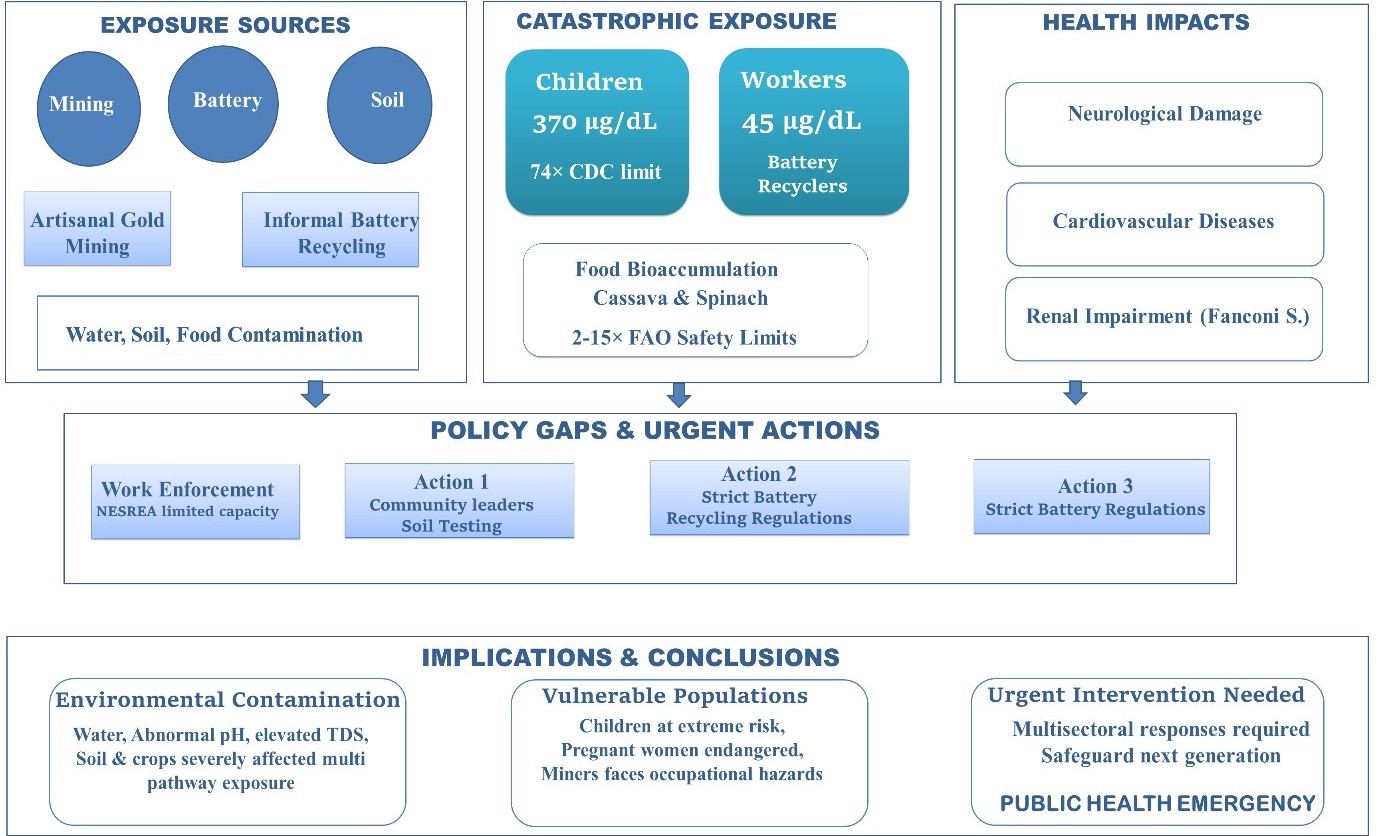
Lead poisoning constitutes a severe public health emergency in Nigeria, disproportionately impacting vulnerable groups including children, pregnant women, and artisanal miners. This systematic review (2005–2025), analyzing 85 studies and agency reports, synthesizes evidence on exposure sources, health effects, and policy gaps. Primary exposure routes include artisanal gold mining and informal lead-acid battery recycling, with secondary contamination of water (abnormal pH, elevated Total Dissolved Solids), soil, and food crops. Blood lead levels (BLLs) reveal catastrophic exposure: children in mining areas exhibit BLLs up to 370 µg/dL, 74× the CDC’s 5 µg/dL reference. Occupational exposure averages 45 µg/dL among battery recyclers. Environmental testing shows staples like cassava and spinach bioaccumulating lead at 2–15× FAO safety limits. Health impacts span neurological damage, cardiovascular disease, and renal impairment (e.g., Fanconi syndrome). Despite the 2010 Zamfara outbreak response, progress stalls due to weak NESREA enforcement and limited remediation funding. We propose immediate actions: (1) community-led soil testing, (2) stricter battery recycling regulations, and (3) nationwide BLL surveillance. This crisis demands urgent, multisectoral intervention to safeguard Nigeria’s next generation.
Downloads
Article Details
Section

This work is licensed under a Creative Commons Attribution-NonCommercial 4.0 International License.
How to Cite
References
[1] Edwards et al. (2017). One Health: Children, Waterfowl, and Lead Exposure in Northwestern Nigeria. Journal of Osteopathic Medicine, 117(6), 370-376. https://doi.org/10.7556/jaoa.2017.075
[2] Edugist Editorial. (2025). Nigeria's hidden epidemic: The burden of lead poisoning and its threat to the nation's future. https://edugist.org/nigerias-hidden-epidemic-the-burden-of-lead-poisoning-and-its-threat-to-the-nations-future/
[3] Anka et al. (2020). Environmental Effect of Lead Contamination on Mining Communities in Zamfara State, Nigeria: A Review. Journal of Biology and Today's World, 9(9), 001-003. https://www.iomcworld.org/articles/environmental-effect-of-lead-combination-of-mining-communities-in-zamfara-state-nigeria-a-review-56745.html#ai
[4] Greig, J., et al. (2014). Association of blood lead level with neurological features in 972 children affected by acute severe lead poisoning outbreak in Zamfara State, Nigeria. PLoS Medicine, 11(4), e1001739. https://doi.org/10.1371/journal.pone.0093716
[5] Davis, L., et al. (2024, August 19). Lead poisoning investigation in northern Nigeria. Centers for Disease Control and Prevention One Health Stories. https://www.cdc.gov/one-health/php/stories/lead-poisoning.html
[6] Gottesfeld, P., & Pain, D. J. (2017). One Health: Children, waterfowl, and lead exposure in northwestern Nigeria. Journal of the American Osteopathic Association, 117(6), 375-383. https://pubmed.ncbi.nlm.nih.gov/28556859/
[7] UNICEF. (2020). The toxic truth: Children's exposure to lead pollution undermines a generation's potential. UNICEF Media Release. https://www.unicef.org/media/73246/file/The-toxic-truth-children%E2%80%99s-exposure-to-lead-pollution-2020.pdf
[8] Moeti, M. (2019, October 28). International Lead Poisoning Prevention Week 2019 - Message of WHO Regional Director for Africa. WHO Africa Regional Office.review: https://www.afro.who.int/regional-director/speeches-messages/international-lead-poisoning-prevention-week-2019-message-who
[9] Page, M. J., et al. (2021). The PRISMA 2020 statement: An updated guideline for reporting systematic reviews. BMJ, 372, n71.
[10] Nduka, J. K., Kelle, H. I., & Ogoko, E. C. (2020). Lead exposure from battery recycling in Nigeria: Health risks and mitigation strategies. Toxicology Reports, 7, 1505–1512. c
[11]Adeyiga, A. B. (2021). Lead poisoning in pediatric groups: A global burden of disease. International Journal of Pediatric Research, 7, 83. DOI:10.23937/2469-5769/1510083
[12] World Health Organization. (2021, October). Lead poisoning and health. https://www.who.int/news-room/fact-sheets/detail/lead-poisoning-and-health
[13] Dooyema et al. (2012). Outbreak of fatal childhood lead poisoning related to artisanal gold mining in Northwestern Nigeria, 2010. Environmental Health Perspectives, 120(4), 601–607. https://doi.org/10.1289/ehp.1103965
[14] Nussbaumer-Streit et al. (2016). Household interventions for preventing domestic lead exposure in children. Cochrane Database of Systematic Reviews, (10). doi: 10.1002/14651858.CD006047.pub5
[15] O’Connor, D., Hou, D., Ok, Y. S., & Lanphear, B. P. (2020). The effects of ubiquitous lead exposure on health. Nature Sustainability,3(2),77-79. https://doi.org/ 10.1038/s41893-020-0475-z
[16] Abadin, H., Ashizawa, A., Stevens, Y. W., Llados, F., Diamond, G., Sage, G., Citra, M., Quinones, A., Bosch, S. J., & Swarts, S. G. (2007). Toxicological Profile for Lead. Agency for Toxic Substances and Disease Registry (US). https://pubmed.ncbi.nlm.nih.gov/24049859/
[17] Lo et al. (2012). Childhood lead poisoning associated with gold ore processing: A village-level investigation Zamfara State, Nigeria, 2010. Environmental Science & Technology, 46(11), 5729–5735. https://doi.org/ 10.1289/ehp.1104793
[18] Nwachukwu, N. A., Udie, S. G., Nchedo, E. N., Ukamaka, U. C., & Olaosebikan, O. O. (2021). Physical and Chemical Properties of Soil, Water and Air around Ukawu Pb-Zn Mine, Southeastern Nigeria. Makara Journal of Science, 25(2), 8. https://doi.org/10.7454/mss.v25i2.1208
[19] Ukpe, A. E., Akhionbare, S. M. O., & Ihejirika, C. E. (2018). The Effects of Mining Activities on the Soil Quality of Ikwo, Ebonyi State Nigeria. International Journal of Advanced Academic Research 7 (12), 88-99. https://www.researchgate.net/publication/357685299_THE_EFFECTS_OF_MINING_ACTIVITIES_ON_THE_SOIL_QUALITY_OF_IKWO_EBONYI_STATE_NIGERIA
[20] Sodimu et al. (2021). Influence of vehicular traffic level on lead content of leaves of some roadside trees in Kaduna City, Nigeria. Australian Journal of Science and Technology 5(2),533-538. https://www.aujst.com/vol-5-2/06_AJST_2021-24.pdf
[21] Onakpa, M. M., Njan, A. A., & Kalu, O. C. (2018). A review of heavy metal contamination of food crops in Nigeria. Annals of Global Health, 84(3), 488-499. https://doi.org/10.29024/aogh.2314.
[22] Orisakwe, O. E., Nduka, J. K., Amadi, C. N., Dike, D. O., & Bede, O. (2012). Heavy metals health risk assessment for population via consumption of food crops and fruits in Owerri, South Eastern, Nigeria. Chemistry central journal, 6(1), 1-7. https://doi.org/10.1186/1752-153X-6-77
[23] Bose-O’Reilly et al. (2017). Lead intoxication in infants and children in Kabwe, Zambia: Implications for child health. Environmental Research, 154, 571–578. https://doi.org/10.1016/j.envres.2017.10.024
[24] Ibeto, C. N., Okoye, C. O. B., & Oparaku, N. F. (2021). Lead contamination in Nigeria: Sources, exposure, and public health implications. Environmental Monitoring and Assessment, 193(3), 1–15. https://doi.org/10.1007/s10661-021-08905-6.
[25] Agency for Toxic Substances and Disease Registry (ATSDR). (2020). Toxicological profile for lead. U.S. Department of Health and Human Services. https://www.atsdr.cdc.gov/toxprofiles/tp13.pdf
[26] Bellinger D. C. (2013). Prenatal Exposures to Environmental Chemicals and Children's Neurodevelopment: An Update. Safety and health at work, 4(1), 1–11. https://doi.org/10.5491/SHAW.2013.4.1.1
[27] Centers for Disease Control and Prevention (CDC). (2023). Lead (Pb) toxicity: What are possible health effects? CDC Archive. https://archive.cdc.gov/www_atsdr_cdc_gov/csem/leadtoxicity/physiological_effects.html
[28] Goyer, R. A., Fowler, B. A., & Onderdonk, A. B. (1993). Toxic effects of metals. In Casarett & Doull’s Toxicology: The Basic Science of Poisons (4th ed., pp. 623–680). https://www.biologicaldiversity.org/campaigns/get_the_lead_out/pdfs/health/Goyer_1996.pdf
[29] Lanphear et al. (2005). Low-level environmental lead exposure and children's intellectual function: An international pooled analysis. Environmental Health Perspectives, 113(7), 894–899. https://doi.org/10.1289/ehp.7688
[30] Navas-Acien, A., Guallar, E., Silbergeld, E. K., & Rothenberg, S. J. (2007). Lead exposure and cardiovascular disease--a systematic review. Environmental health perspectives, 115(3), 472–482. https://doi.org/10.1289/ehp.9785.
[31] Nemsadze, K., Sanikidze, T., Ratiani, L., Gabunia, L., & Sharashenidze, T. (2009). Mechanisms of lead-induced poisoning. Georgian medical news, (172-173), 92–96. https://pubmed.ncbi.nlm.nih.gov/19644200/
[32] Nriagu, J. O., Ohanjanukraw, O., Oleru, U. B., & Afiukwa, O. C. (2014). Blood lead levels in children attending a tertiary teaching hospital in Enugu, Nigeria. Tropical Medicine & International Health, 19(8), 934–939. https://doi.org/10.1111/tmi.12307
[33] Patrick L. (2006). Lead toxicity, a review of the literature. Part 1: Exposure, evaluation, and treatment. Alternative medicine review: a journal of clinical therapeutic, 11(1), 2–22. https://pubmed.ncbi.nlm.nih.gov/16597190/
[34] Adesina, O. A., Oladipo, O. O., Fawole, O. O., & Adeola, M. S. (2023). High blood lead levels of children in a gold mining community in Osun State, Nigeria. Transactions of the Royal Society of Tropical Medicine and Hygiene, 117(10), 714–720. https://doi.org/10.1093/trstmh/trad035
[35] World Bank. (2025). Nigeria population data. World Bank Open Data. https://data.worldbank.org/country/nigeria
[36] Abduljalal, D., Abdullahi, G. M., & Abubakar, U. M. (2020). Blood lead levels of mining communities of Zamfara State, Nigeria. African Journal of Pharmaceutical Research and Development, 12(1), Article 09. https://ajopred.com/wp-content/uploads/2020/03/AJOPRED-12-1-Aritcle-09.pdf
[37] Ajumobi et al. (2014). High concentration of blood lead levels among young children in Bagega community, Zamfara – Nigeria and the potential risk factors. Nigeria Field Epidemiology and Laboratory Training Programme. https://pmc.ncbi.nlm.nih.gov/articles/PMC4199350/.